Putting Three Quotes on One Page
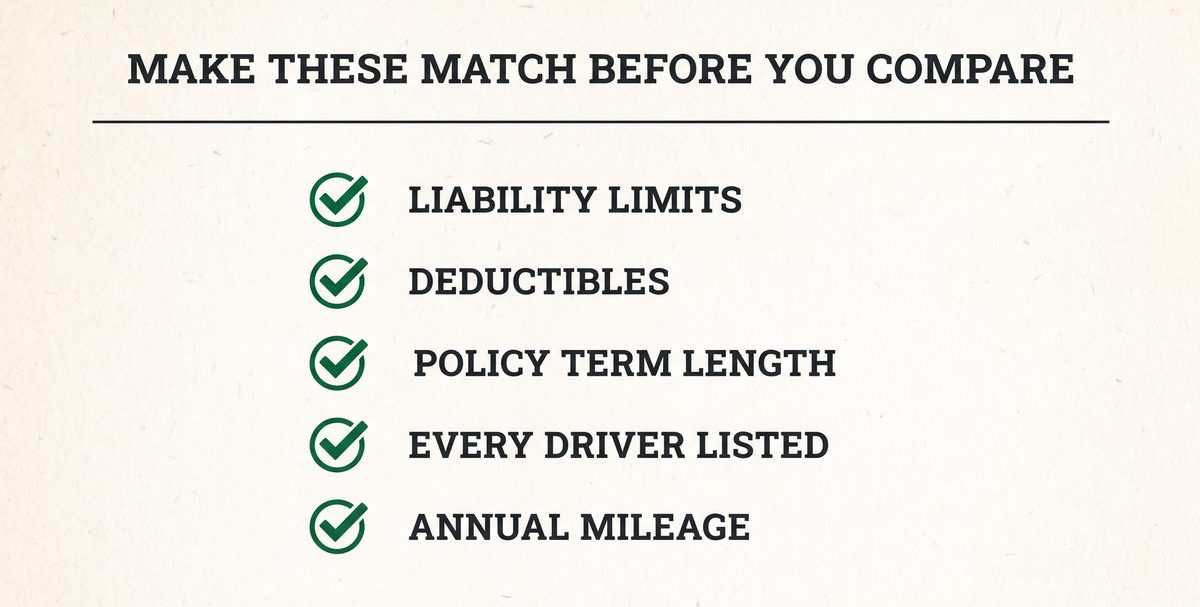
Comparison fails at the organization step far more often than at the collection step. People gather quotes, mean to sit down with them, and end up choosing on a half-remembered impression of which one seemed cheapest. Here is the sheet that fixes that — it takes about ten minutes and it survives being done on a phone.
Section one: the identity rows
These must be identical across every column. If they are not, stop and fix that before going further.
Readers who want the paperwork side can follow the guide to getting car insurance quotes online, which lists what the DMV and the carrier each need.
- Vehicles, by VIN
- Every listed driver
- Garaging address
- Annual mileage per vehicle
- Vehicle use for each
- Effective date
Identical inputs are what make the rest of the sheet mean anything. Anything that differs here invalidates the comparison rather than adjusting it.
Section two: the coverage rows
These are the ones to normalise. Fill each in from the quote document itself:
- Bodily injury per person / per accident
- Property damage
- Uninsured and underinsured motorist, or "rejected"
- Uninsured motorist property damage
- Medical payments
- Comprehensive deductible
- Collision deductible
- Rental reimbursement, with the daily and total caps
- Roadside
- Any endorsements
If a row differs between columns, either re-quote to match or write the difference in red so it cannot be forgotten when you look at price.
Section three: the money rows
- Policy term — six or twelve months
- Premium for the term
- Annualised premium — the row you actually compare
- Due today
- Per installment, including fees
- Total across the term
Section four: the rows nobody fills in and everybody should
- Carrier's financial strength rating, looked up rather than asserted
- How a claim gets reported, and whether there is a local presence
- Whether you can reach a person for a mid-term change
- What verification is still outstanding on this quote
- How long the quote is valid
How to read the finished sheet
Work top down. If the identity rows match and the coverage rows match, the annualised premium row is a clean read and the lowest number is genuinely the lowest price for the same product. If the coverage rows do not match, the price row is decoration.
Where two columns land close together, section four decides it. That is the point of filling those rows in — so that when price is a tie you have something better than a coin flip.
Keep the sheet
File it with the date. Next time you shop — after a renewal, a move, or a change in the household — you will start from a completed baseline instead of from scratch, and you will be able to see whether the market moved or you did.
If you would rather have the sheet built for you, that is essentially what we do: one set of inputs, several carriers, the same rows for each.
Two rows that decide close calls
When two columns land within a few dollars of each other, the money rows have stopped helping and section four is all you have left. Two entries there do most of the work.
What is still to be verified. A quote where the carrier has already pulled your records and confirmed the vehicle is a firmer number than one built entirely on what you typed. If the prices tie, take the more verified one.
What happens on a missed payment. Nobody plans to miss one, and a cancellation for non-payment leaves you uninsured until you replace it — a far bigger risk than the difference you are weighing. A carrier with a clearer, more forgiving process is worth real money.
Doing it on a phone
You do not need a spreadsheet. A note app with one carrier per block, the same rows in the same order each time, works fine and survives being filled in while you are on hold. The discipline that matters is the order — identity rows, coverage rows, money rows, then everything else — not the tool.
Get this quoted for your situation
Free quotes from multiple carriers, prepared by a licensed California agent. Two minutes, no obligation.
Get My Free QuoteMore of what callers ask
Is three quotes enough?
For a straightforward driver, three well-matched quotes usually show you where the market sits. If your situation is one carriers disagree about — a young driver, a recent violation, an SR-22 filing — a wider spread of companies is worth the extra effort.
Should I keep old quotes?
Yes, with dates. They are useful context next time, and they let you see whether a renewal increase reflects the whole market moving or just one carrier. They are not valid offers after they expire, though.
What if a carrier will not give me a written quote?
Ask for it in writing anyway. A verbal figure with no coverage detail cannot be placed on this sheet, and a quote you cannot document is not something you can hold anyone to.