Is That Actually a Quote?
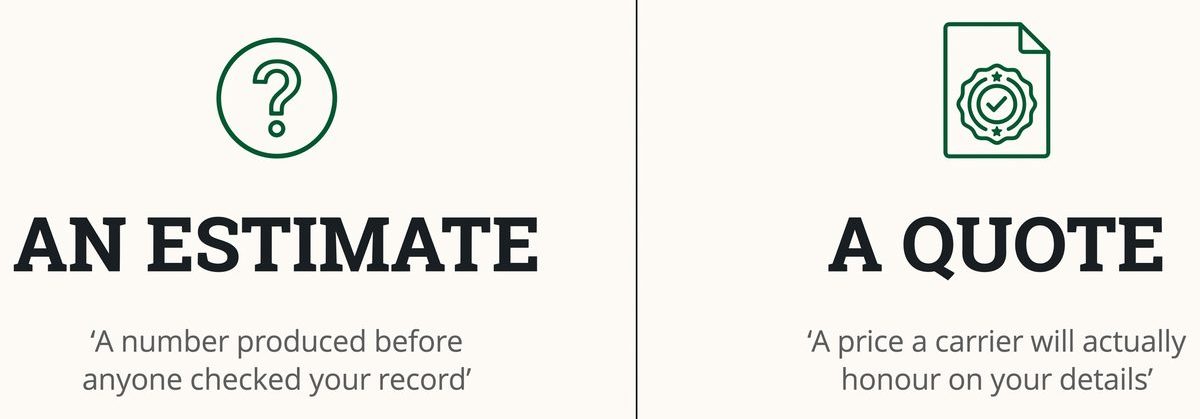
Numbers arrive from a lot of directions when you are shopping — advertised starting prices, calculator outputs, ballpark figures from a phone call, and actual quotes. They are not the same thing, and treating an estimate as a quote is how people end up canceling a good policy for a price that was never available.
What makes something a quote
A real quote is specific and documented. It names:
Readers who want the paperwork side can follow the guide to getting car insurance quotes online in California, which lists what the DMV and the carrier each need.
- The underwriting company that would issue the policy
- Every vehicle, by VIN
- Every driver
- Each coverage with its limit, and each deductible
- The policy term and the effective date it was built for
- The premium, and the payment schedule
- Usually, a validity period
If a number is missing most of that, it is an indication, not an offer. Ask for it in writing — a carrier or agent that will not put a quote in writing has told you something.
The three things that are not quotes
An advertised starting price
Advertising describes what some qualifying drivers pay under some circumstances. It is not a statement about you. Our own site carries a starting figure of 29 dollars a month for qualifying drivers, and we say plainly every time it appears that it is an advertised starting point, not a quote — your own number depends on your record, mileage, vehicle and coverage choices. Any advertised price anywhere deserves exactly that reading.
A calculator or estimator output
Useful for orientation, built on assumptions you did not choose, and generated without touching a carrier's rating system. Fine for deciding whether to bother shopping. Not something to act on.
A verbal ballpark
"You'd probably be around…" is a helpful human answer and it is not a price. It has no coverage detail attached, so there is nothing to compare it against.
Even a real quote is conditional
A documented quote is built on the information supplied and remains subject to verification and underwriting. Records get pulled, addresses get checked, vehicles get confirmed. That is normal, and it is why the question "what is still to be verified?" belongs in every shopping conversation.
The practical rule that follows: do not cancel your existing policy on the strength of a quote. Cancel it once the new policy is bound and in force, with the effective dates overlapping. A quote is a proposal; a binder or an issued policy is coverage.
The checklist before you act on a number
- Is it in writing, with the underwriting company named?
- Are all the coverages and deductibles listed?
- Is the term stated, and the effective date?
- Is there a validity period?
- What is still to be verified?
- Is it bound, or only quoted?
Six questions. If the answers are good, you have something you can compare and act on. If they are not, you have a number. Ask us for a written quote with the company named — that is the form a comparison needs to be in before anyone should be canceling anything.
Get this quoted for your situation
Free quotes from multiple carriers, prepared by a licensed California agent. Two minutes, no obligation.
Get My Free QuoteMore of what callers ask
Is an online instant quote a real quote?
It can be, if it names the underwriting company and lists the specific coverages and deductibles. Many are estimates built on assumed coverage levels, so check what is actually on the page before treating it as an offer.
Can I rely on an advertised price?
No. Advertised figures describe what some qualifying drivers pay in some circumstances, not what you will pay. Your own number depends on your record, mileage, vehicle and the coverage you choose.
When is it safe to cancel my old policy?
Only after the new policy is bound and confirmed in force, with an effective date on or before the old one ends. Canceling on the strength of a quote risks a gap if anything about the new policy changes at underwriting.